Suppose you need one specific module for your store — an integration with a marketplace you have just started selling on, or a shipping calculator nobody sells off the shelf. Commissioning that work for yourself costs from several hundred dollars, and paying the full price alone for something dozens of similar stores also need is a poor deal. Pooled development funding solves exactly that: several interested owners chip in on a single commission, and the developer builds it once for all of them. Before organising a pool, it is worth checking the extensions catalogue: if the module you need is already there, paying to have it built again makes no sense.
This is not charity, and it is not "let's agree in a group chat". It is a formal mechanism with escrow, an activation threshold, a visible work board and an independent arbiter. Below is an honest account of how it works on CommerCentr — including the limits worth knowing before you start.
What it is, in plain terms — and what it is not
A pooled campaign is a shared development order funded by many participants at once. One buyer creates the campaign: describes the blocks of work needed (say, "product catalogue", "cart", "payment integration") and sets a deadline. A developer sees the request, sizes it up — setting a total budget and contribution tiers — and confirms they will take it on. Everyone else then joins with their contributions until both the required sum and the required number of participants are reached.
To avoid confusion, here is how it compares with the two familiar alternatives:
| Freelance marketplace | Paying a developer directly | Pooled campaign | |
|---|---|---|---|
| Who pays | one client | one client | many participants together |
| Money before delivery | often prepaid on trust | prepaid directly | held in platform escrow |
| If it falls through | refund by agreement | depends on the contractor | automatic refund, no fee |
| Who settles a dispute | you and the contractor | you and the contractor | the platform as arbiter |
| What it costs you | 100% of the price | 100% of the price | your share of the pool |
The core difference is that you share both the cost and the risk. In exchange, responsibility for accepting the work becomes shared too — which is why the mechanism is deliberately built around keeping the money safe.
How the escrow works, and what happens to your money
This is the first question anyone asks when they hear "let's all chip in for development", so let us settle it immediately.
When you join a campaign, your contribution does not go to the developer. It is reserved in escrow — on a platform-held technical account that neither side can draw from early. The money moves in exactly two situations:
- Success. The work is finished and an independent party — the platform acting as arbiter — confirms it matches the stated scope. Then, and only then, the funds are debited from participants and credited to the developer. The marketplace takes its fee only in this case: 30%, leaving the developer 70%.
- Failure or rejection. The campaign missed its threshold, the developer did not deliver, or the arbiter did not accept the result — every participant gets their full contribution back, with no fee deducted.
One detail deserves to be understood precisely: the fee is charged solely on a successful payout to the developer. Refunds are always complete. What you risk is waiting time, not money.
There are deliberately no staged payments. The developer can publish interim pre-releases for testing, but they all belong to a single stage. Funds settle once, at the end, on an all-or-nothing basis. That removes the classic freelance argument — "I've done half, pay me half" — where the two sides value that "half" very differently.
The activation threshold and the funding window
A campaign does not start until critical mass is reached. That protects both sides: nobody begins work that one and a half people have agreed to pay for.
So a campaign carries two separate deadlines:
- The funding deadline — by which the minimum number of participants and the required sum must be gathered. Until the threshold is met the campaign is not indexed by search engines and does not appear in the general catalogue; it is reachable only by direct link, a banner, or the dedicated "now funding" block. An unfinished campaign therefore does not clutter search results or mislead anyone about its status.
- The delivery deadline — by which the developer must deliver, once funding has closed and work has begun.
What if funding falls short? The rule is simple and free of traps. Some time before the funding deadline, if the threshold is still unmet, the initiator and every participant are notified: the campaign has not filled up — is it still relevant, should the window be extended? The initiator can extend the funding period — to invite a few more people, for instance. If the deadline passes and the threshold is still not reached, the campaign closes and everyone is refunded in full, with no fee. No artificial "only 2 slots left" — just real dates and a real threshold.
How to organise one: step by step
Say you run a store on a tight budget and want a specific module. Here is the path from idea to working code.
- 1. Create the campaign. In your buyer dashboard, describe the blocks of work you need — one per line, since each becomes a card on the development board — and set a delivery deadline. That is your specification in broad strokes.
- 2. Wait for a developer. A marketplace developer sees your request, sizes up the scope and confirms: total budget, a few contribution tiers, and the funding deadline.
- 3. Gather participants. Share the campaign link where people with the same need gather. Each picks a tier and joins; their funds are reserved in escrow.
- 4. Threshold reached — work starts. Once both the participant minimum and the sum are in, the campaign activates and the developer starts moving the board.
- 5. Watch and test. Participants see progress and receive pre-releases to check the direction.
- 6. Acceptance. At the end the arbiter checks the result against the stated scope. Accepted — the developer is paid and you get the module. Not accepted — you are refunded.
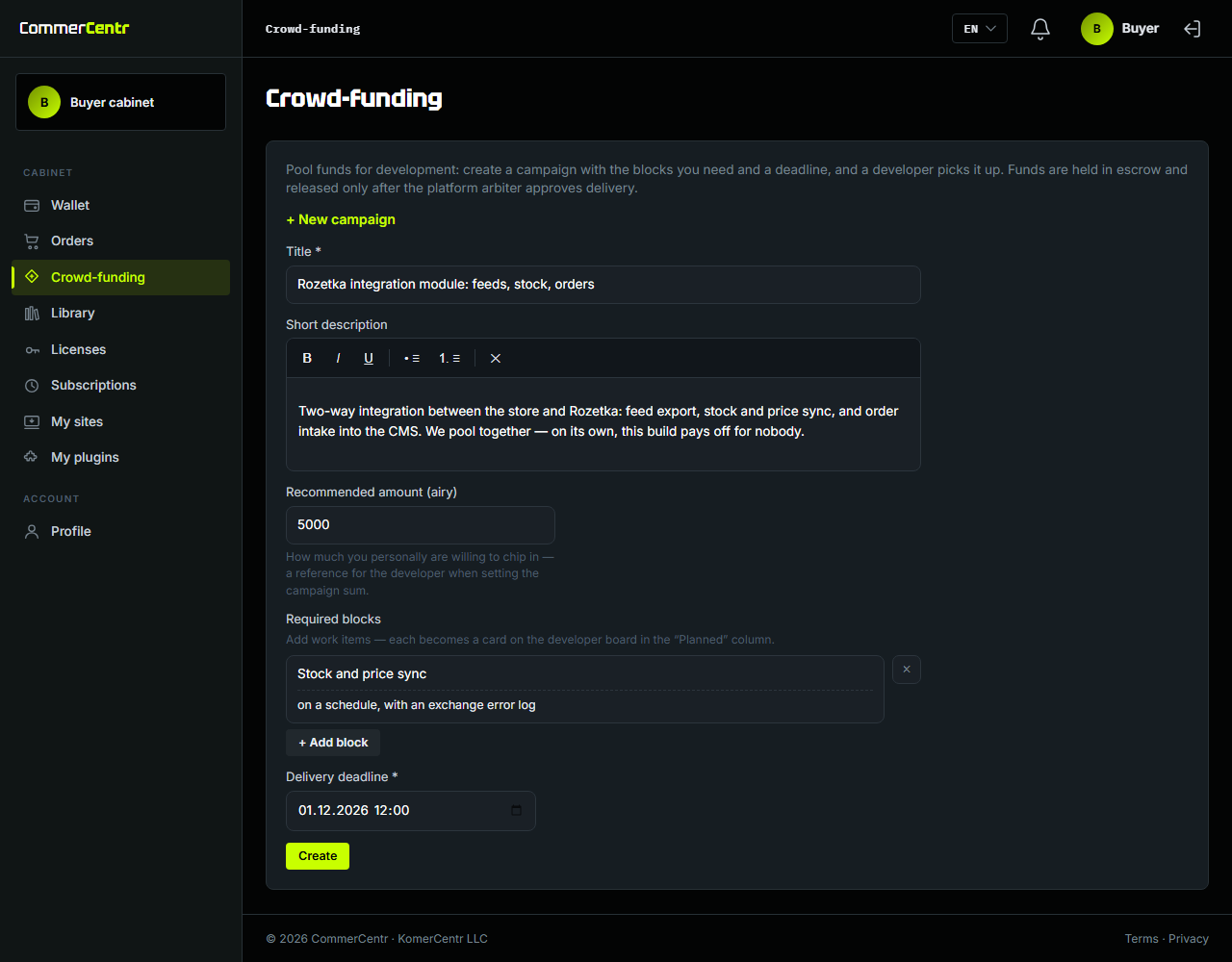
Step 1. Every line under "Required blocks" becomes its own card on the development board.
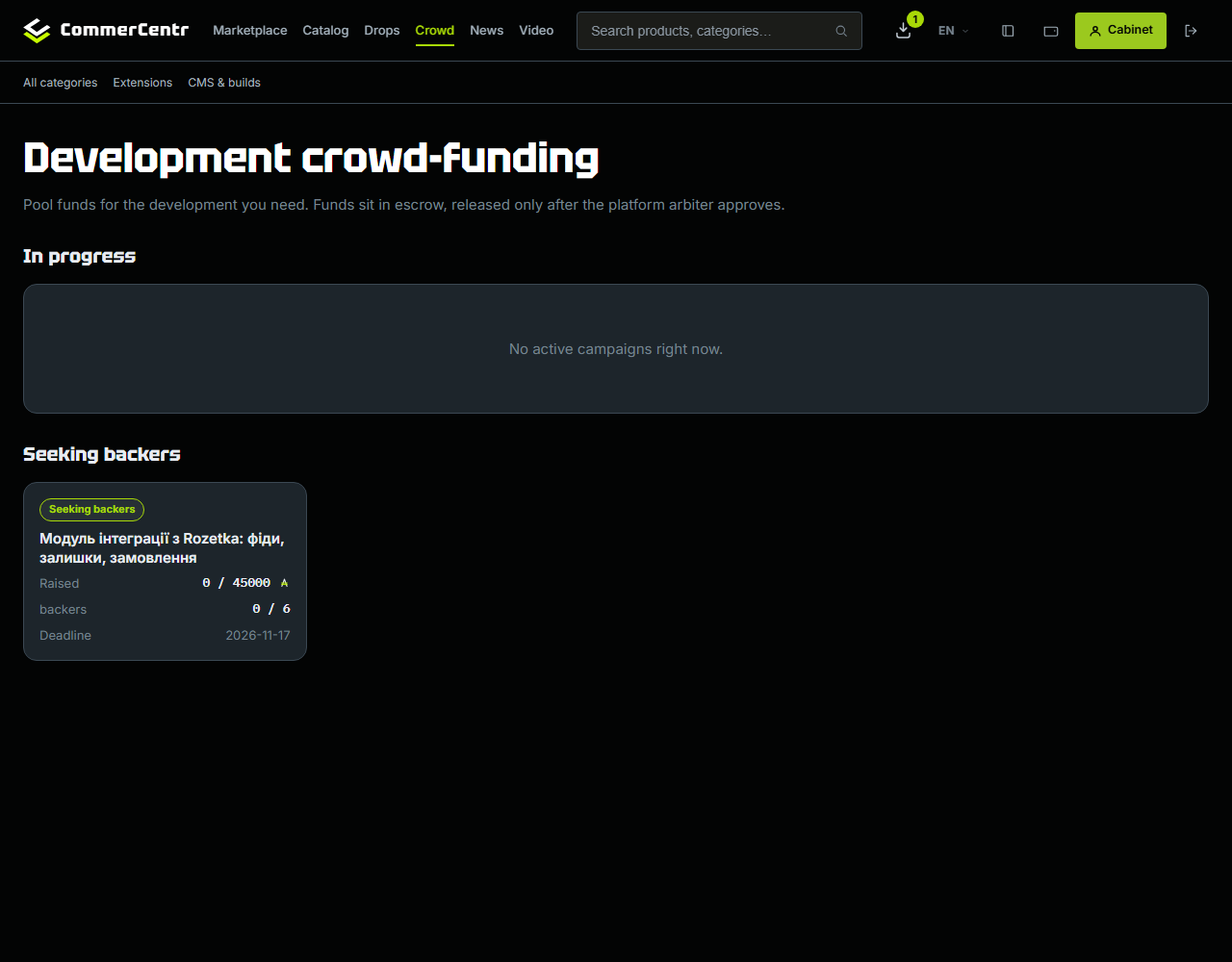
Step 2. Open campaigns sit on the exchange — this is where a developer picks yours up.
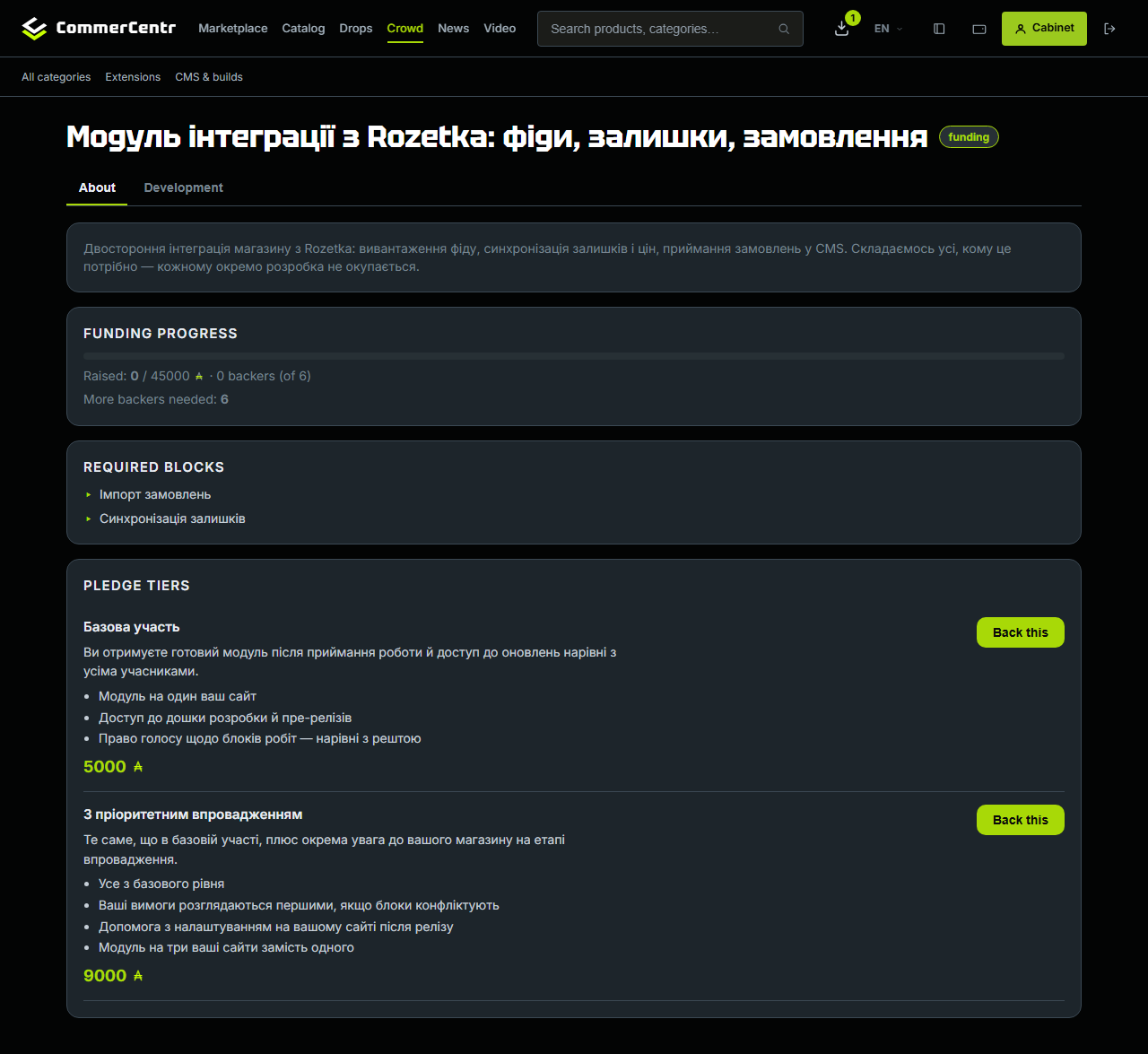
Step 3. This is what the people you invite see — terms and tiers, before anyone pays.
One piece of advice: write the blocks concretely. "Courier integration: rate calculation plus tracking" is far easier to verify than a vague "sort out shipping". The sharper the blocks, the fewer grounds for argument at acceptance.
Visible progress: the board and pre-releases
The biggest anxiety in any shared commission is that nothing is actually happening behind the scenes. So progress is shown the same way as on an ordinary commissioned brief: a kanban board with "To do → In progress → Review → Done". Each of your blocks becomes a card, and you can see which column it sits in.
The board is visible only to the parties of the campaign — the initiator, the developer, and everyone who contributed. It is not a public scoreboard: an outside visitor sees the description and the funding progress, not the internals. Alongside moving cards, the developer publishes interim pre-releases so participants can check the direction before final acceptance.
For the detail-minded: the mechanism deliberately reuses the existing service-order engine — the same one behind individual briefs — rather than a parallel system of its own. Pooled funds are held separately from the board's carrier record, so none of the standard service-payment paths can accidentally charge them twice. That separation is enforced in code.
Who benefits — and where the limits are
Honestly, about who this suits:
- Tight budgets. The main benefit is that you pay your share, not the whole development cost. One needed module split across several buyers is the difference between "someday" and "this month".
- Anyone wary of paying up front. Escrow, full fee-free refunds and an independent arbiter remove the central fear of prepayment. You risk time, not money.
- The technically exacting. A transparent threshold, a board, pre-releases and explicit acceptance rules — instead of gentlemen's agreements.
And the limits worth knowing:
- It is slower than commissioning directly: gathering participants takes time. If you need the module yesterday and only you need it, commissioning development outright is faster.
- The result is shared. You shape the specification together with other participants, not alone.
- The fee applies on success — a fair price for the escrow guarantee and arbitration, but budget for it (30%).
Pooled funding does not replace everything; it is a tool for one specific situation — when the same thing is needed by many, and paying full price alone makes no sense.
In short
Pooled development turns "a shame this costs too much for me alone" into "let's do it together, safely". A transparent threshold, escrow, fee-free refunds on failure, an independent arbiter and a visible board — the mechanism is built so that trust rests on rules rather than promises.
If you have an idea for a module or an improvement that almost certainly is not needed by you alone, start a pooled campaign and find out how many people are ready to chip in with you.